
Meta Muse AI Agent. How AI Shopping Could Change Affiliate Marketing
Published: 23.09.2026
The Meta Muse AI agent can independently search for information online, compare products, and even make purchases on behalf of users. Meta’s new service is currently available only in the USA, but its launch already shows how AI could change the traditional user journey from recommendation to purchase.
Previously, a user could read a review, follow an affiliate link to an advertiser’s website, and place an order. Now, an AI agent may appear between the content and the purchase. It can find the right product, compare offers, and complete the purchase on its own.
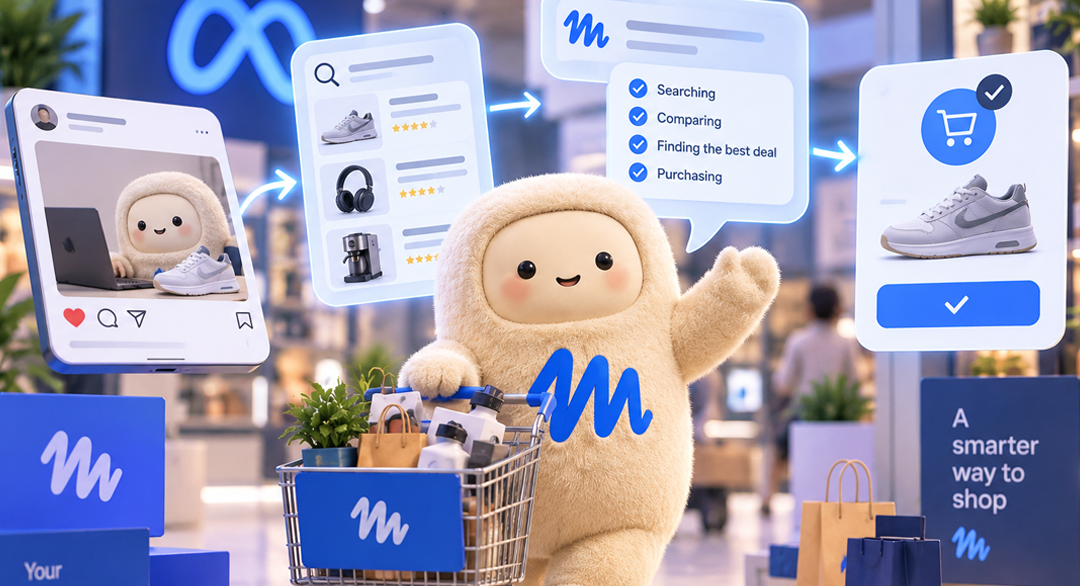
This raises an important question: “Who gets the commission if a user’s decision was influenced by an affiliate’s content, but the actual purchase was made by AI?”
What Is the Meta Muse AI Agent and How Does It Work?
Muse is more than just another AI chatbot. Its key difference is that it can not only respond to user requests but also perform specific actions. Users can give the agent a task or set a long-term goal. Muse then creates a plan, opens a browser, searches for the necessary information, fills out forms, and can continue working in the background even after the app is closed. If a decision or user confirmation is required to proceed, the agent contacts the user.
Meta provides several examples of how Muse can be used: наводить Meta:
- booking tickets and hotels
- managing bills
- selling a car
- creating a grocery list based on a saved Instagram recipe
Muse can also remember user preferences and take information from previous conversations into account when making future recommendations. At launch, the Meta Muse AI agent is available to adult users in the USA through dedicated iOS and Android apps, the Muse.ai website, and WhatsApp. The basic version of the service will be free, while paid subscriptions will be available for more extensive use.
Meta Muse Can Not Only Find a Product but Also Buy It
One of Muse’s most interesting capabilities is that the agent can make online purchases on behalf of users. Payments are processed through Link by Stripe. The payment system creates a one-time card, so the AI agent does not need to see or enter the buyer’s actual bank card details on the website.
Muse can’t perform sensitive actions without confirmation. Before sending an email, making a purchase, or carrying out other similar actions, the agent must obtain the user’s permission.
Another important feature is that Muse has its own browser. This means it is not limited to a single marketplace or a specific retailer’s catalog. The agent can navigate between external websites, search for information, and compare different offers.
At the same time, this approach may create issues with online stores that restrict automated agents. The fact that an AI agent is technically capable of interacting with a website does not necessarily mean that a particular retailer allows such actions.
How Meta Protects Muse User Data
Each user gets a separate Muse Secure VM, an isolated virtual computer in the cloud. This environment stores connected services, files, and credentials.
Access to external services is additionally controlled by a system called Sentinel. Users decide which apps Muse can access and can revoke those permissions later.
Meta states that conversations and data stored in the Muse Secure VM will not be shared directly with the company’s advertising systems. However, there is an important nuance. The AI agent’s online activity may still indirectly influence advertising. For example, if Muse visits an online store, the retailer may record this visit as user activity and later use it for retargeting.
At the same time, the technology is not yet flawless. According to Reuters, internal testing revealed issues with authentication, interrupted task execution, and the security of personal information.
Although companies such as Meta pay considerable attention to security, we are only at the beginning of the AI agent era. Therefore, issues related to errors, personal data protection, and control over the actions of virtual assistants are likely to remain relevant for a long time.
How the Meta Muse AI Agent Could Affect Affiliate Marketing
For the affiliate industry, one of Muse’s most important features is the emergence of a new step between the content that influenced the user and the actual purchase.
For example, a user reads a smartphone review on an Instagram page. They then ask Muse to find that model, compare prices across different stores, and buy it wherever the conditions are best.
The purchase decision may have been influenced by affiliate content. However, the user does not click an affiliate link. Instead, the AI agent handles the rest of the journey. Which websites Muse will use to search for information and which offer it will ultimately choose is a separate question.
This is where the issue of affiliate commissions arises. Meta has not yet explained whether Muse will preserve affiliate parameters when navigating between websites, recognize affiliate links, or pass information about the source that influenced the recommendation and subsequent purchase. If this information is lost, an affiliate may effectively lead the user to a purchase decision but receive no commission for it.
This is therefore one of the biggest questions surrounding the development of Meta Muse for the affiliate industry. We will have to see whether technical mechanisms emerge that can recognize the contribution of the original source to a conversion.
How AI Is Changing the Traditional Funnel
The traditional user journey in affiliate marketing can be simplified as follows:
Content → affiliate link → advertiser’s website → purchase.
With the emergence of AI agents, this journey may become more complex:
Content → user → affiliate link → no conversion → AI agent → search and comparison of offers → advertiser’s website → purchase.
In this scenario, the affiliate has already invested resources in attracting the user and influenced their decision, but the final purchase takes place through a different path. As a result, the conversion is not attributed to the affiliate, and they do not receive a commission.
Content → user → affiliate link → no conversion → AI agent → search and comparison of offers → affiliate link → advertiser’s website → purchase.
Here, the AI agent finds an affiliate page itself while searching for information. In this case, it becomes important for affiliates not only to convince users but also to make their content clear and accessible to AI systems. However, keep in mind that this lead has effectively cost the affiliate twice as much: the user + the AI agent.
In some scenarios, users may barely interact with websites themselves at all. AI could handle a significant part of the journey from searching for information to completing an order on their behalf.
This continues a trend that the affiliate industry is already seeing with the development of AI search. Publishers’ content can influence users’ decisions even when they do not visit the original source directly.
That is why it is worth paying more attention to how websites, product comparison sites, and content are structured, and how easily AI systems can extract the information they need. We explained in detail how to prepare your product comparison sites in our article “Website Optimization for AI. A Guide for Affiliates.”
Meta Muse and Affiliates
It is still too early to say that the Meta Muse AI agent will radically change affiliate marketing. The service is only being launched, is currently available only in the USA, and Meta has not yet revealed many details about how it will handle affiliate links and attribution.
However, this is an important signal for the industry. If AI agents become a common tool for online shopping, it will be necessary to identify conversion sources more accurately and account for situations where AI appears between the initial advertising interaction and the purchase.
For affiliates, the value of high-quality content is not disappearing. On the contrary, reviews, comparisons, product specifications, and expert content may become sources of information not only for people but also for the AI systems that help them make decisions.
However, attribution remains the key issue. If AI uses information created by an affiliate but completes the purchase through a different path, the industry will need mechanisms that preserve the connection between the source of the recommendation and the conversion.
AI-powered shopping should therefore be viewed as the next stage in the transformation of affiliate marketing. AI is changing the user journey to purchase, and affiliate marketing is changing along with it. That is why affiliates need not only to keep up with new technologies but also to work with reliable affiliate programs, and tools for traffic monetization.
Register on the SalesDoubler platform, choose affiliate programs that match your traffic, and earn with us even as the rules of the game continue to change.

SalesDoubler.pro content manager