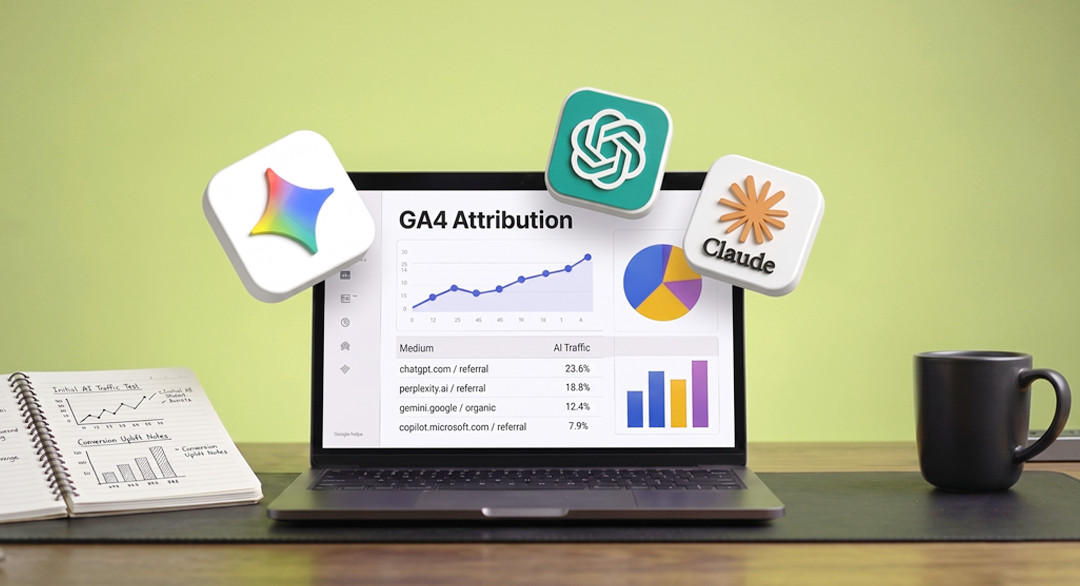
AI Traffic in GA4. How to Track Visits from ChatGPT, Gemini, and Claude
Published: 04.06.2026
Just a few years ago, most marketers focused only on traditional traffic acquisition channels such as organic search, paid advertising, social media, and referral traffic. Today, artificial intelligence has firmly joined that list. AI traffic in GA4 is gradually becoming a separate area of analytics for marketers and affiliate teams. Millions of users turn to ChatGPT, Gemini, Claude, and other AI assistants every day. They want to find answers to questions, compare products, and get recommendations before making a purchase. This is the emergence of a new traffic source that is steadily influencing the customer journey and path to conversion. The challenge was that, for a long time, this traffic was difficult to track. Most visits from AI chatbots were grouped under Referral or even Direct traffic. They making it nearly impossible for marketers to accurately measure their impact and performance.
If you’ve spent the last year trying to figure out how much traffic is actually coming from ChatGPT or Claude, you’ve probably run into the same issue. Most of those visits simply disappeared into the Referral or Direct buckets. That’s why the launch of the new AI Assistant channel in Google Analytics 4 has become a notable development for the affiliate marketing industry.

Key Takeaways. What Affiliate Marketers Should Know About the AI Assistant Channel in GA4
- Key Takeaways. What Affiliate Marketers Should Know About the AI Assistant Channel in GA4
- What Is the AI Assistant Channel in Google Analytics 4?
- Why AI Traffic in GA4 Matters for Affiliate Marketing
- How to Find AI Traffic in GA4
- Why Some AI Traffic Still Gets Lost
- What Type of Content Do AI Assistants Cite Most Often?
- Why AEO Is Becoming the Next Evolution of SEO
- GA4 now has a dedicated channel for AI traffic. Visits from AI assistants such as ChatGPT, Gemini, and Claude can now be automatically categorized under the AI Assistant channel. It’s making this traffic much easier to analyze.
- The need for complex regex configurations is decreasing. Previously, marketers had to create custom filters and channel groups to separate chatbot traffic from standard referral traffic. Now, Google Analytics 4 handles part of that work automatically.
- Not all AI traffic will be classified correctly. If a user opens a link through a mobile app, an in-app browser, or manually copies and pastes a URL, referral data may be lost. In these cases, visits often end up in the Direct traffic category.
- Google AI Overviews are not included in the AI Assistant channel. Traffic from AI Overviews and AI Mode remains part of Google Search reporting and continues to be classified under Organic Search rather than AI Assistant.
- Start collecting benchmark data now. Since the new channel is still building historical data, it’s worth tracking sessions, engagement metrics, top-performing landing pages, and conversions. This will help you more accurately measure the impact of AI-driven traffic on your affiliate campaigns over time.
What Is the AI Assistant Channel in Google Analytics 4?
On May 13, 2026, Google introduced a new AI Assistant channel in Google Analytics 4. Its primary purpose is to automatically identify visits coming from popular AI assistants. Group them into a separate traffic channel.
Google has already confirmed support for ChatGPT, Gemini, and Claude. When GA4 detects a visit from one of these sources, it automatically assigns the value ai-assistant to the Session Medium dimension and categorizes the session under the AI Assistant channel. At first glance, the update may seem relatively minor. After all, it’s just another channel added to the reports. However, for marketers and affiliate teams who work with analytics on a daily basis, the impact is much more significant. It means less manual work, cleaner reporting, and a clearer understanding of where traffic is coming from.
Previously, teams often had to create custom channel groups. It maintain complex rules to separate AI-driven traffic from standard referral traffic. Every time an AI platform changed the way it passed referral data, those rules had to be updated. With the introduction of the AI Assistant channel, much of that process is now handled automatically by Google Analytics 4.
Why AI Traffic in GA4 Matters for Affiliate Marketing
For affiliate teams, it’s not enough to know that a user visited a website. What matters even more is understanding where that user came from and how valuable that visit turned out to be. This is where AI traffic in GA4 opens up new opportunities for analysis. Users arriving from ChatGPT, Claude, or other AI assistants often behave differently from visitors coming through traditional search engines. In many cases, they have already received an answer to their question, reviewed recommendations. Moved closer to making a decision before they even land on your website.
For example, a user might ask ChatGPT to recommend the best online lending service. If your comparison website is mentioned in the response. The user clicks through. They are already arriving with a certain level of trust and a clearer intent to take action.
In practice, this means that AI-driven traffic can deliver more value to a business even when the number of visits is lower. These users are not simply browsing an article out of curiosity. They are actively looking for a solution, comparing options, or preparing to complete a specific action, such as signing up, submitting a lead form, or making a purchase.
How to Find AI Traffic in GA4
Tracking the new channel does not require any additional tags, custom setups, or UTM parameters. If Google Analytics recognizes a supported AI assistant as the traffic source, the visit will automatically be assigned to the appropriate report.
To view this data, open Reports, navigate to Acquisition, and select Traffic Acquisition. Then set Session Default Channel Group as the primary dimension.
Reports > Acquisition > Traffic Acquisition
If your website has already received visits from supported AI platforms, you will see AI Assistant listed among your traffic channels. From there, you can compare its performance against channels such as Organic Search, Referral, and Direct.
It’s also a good idea to save this report in the Library section. Use it as a dedicated benchmark when evaluating content performance. Over time, this will help you better understand how AI-driven traffic contributes to engagement, conversions, and overall affiliate marketing results.
Why Some AI Traffic Still Gets Lost
Although the introduction of the AI Assistant channel is a major step forward. It does not completely solve the challenge of tracking AI-driven traffic. Google Analytics can only classify visits when referral information is available. If a user opens a link through a mobile app, an in-app browser, or manually copies and pastes a URL from an AI-generated response, the referral data may be lost before GA4 can process it. As a result, these visits are often categorized as Direct traffic.
This is why it’s important not to fall into the trap of relying solely on the numbers you see in the AI Assistant channel. The data shown there does not represent the full impact of AI on your website. It only reflects the portion of AI-driven traffic that Google Analytics can successfully identify and classify. For this reason, marketers should not completely abandon their existing tracking methods or custom reports for monitoring AI-related traffic sources.
Many affiliates and website owners may open the AI Assistant report and see only a few dozen sessions. It can be tempting to conclude that AI traffic is still insignificant. However, such conclusions may be premature. A portion of AI-driven visits continues to disappear into the Direct traffic category, which means the real influence of ChatGPT, Claude, Gemini, and other AI assistants could be much greater than current reports suggest.
Another important limitation is that Google has not published a complete list of supported AI traffic sources. While the company has officially confirmed support for ChatGPT, Gemini, and Claude, it has not disclosed every platform included in its classification system. As a result, visits from tools such as Perplexity, Grok, DeepSeek, Copilot, and other AI-powered discovery platforms may appear inconsistently in reports. Some traffic may be categorized as Referral, while other visits may end up in Direct. This situation will likely continue to evolve as Google expands the list of recognized AI assistants and improves its traffic classification capabilities over time.
What Type of Content Do AI Assistants Cite Most Often?
Over the past year, clear patterns have started to emerge regarding the types of content most frequently referenced by AI assistants. In most cases, AI tools favor content that provides a direct, clear, and useful answer to a specific user question.
When analyzing AI-driven traffic, it’s important to view the new AI Assistant channel not just as another metric, but as a tool for measuring business outcomes. Compare AI Assistant traffic with Organic Search and Referral traffic. Look at which pages receive the most visits from AI assistants, whether conversion rates differ, and which pieces of content generate the highest number of leads and sales.
In many cases, AI-driven traffic may be smaller in volume but higher in quality.
Users arriving from AI-generated recommendations often have stronger intent and are further along in the decision-making process than the average visitor. The content that tends to perform best includes detailed how-to guides, product reviews, service comparisons, pricing pages, and articles designed to solve a specific problem. These formats align closely with how AI assistants generate responses and provide recommendations.
This type of content follows the principles of AEO (Answer Engine Optimization). The practice of optimizing content for answer engines that generate direct responses to user queries. The more accurately a page answers a specific question, the more likely it is to be referenced, cited, or recommended by AI assistants such as ChatGPT, Gemini, and Claude.
Why AEO Is Becoming the Next Evolution of SEO
The growing adoption of generative AI is gradually changing the way marketers approach search optimization. Traditional SEO focuses on improving rankings in search engine results pages, while AEO (Answer Engine Optimization) is designed to help content appear directly within AI-generated answers.
For now, AI-driven traffic cannot compete with organic search in terms of volume. However, it has already become significant enough to track separately and evaluate based on its impact on conversions and business outcomes. The launch of the AI Assistant channel in Google Analytics 4 marks one of the first major steps toward more transparent measurement of AI-driven website traffic. Affiliate marketers can now analyze visits from ChatGPT, Gemini, and Claude independently, compare them with traditional acquisition channels, and assess their contribution to leads, sales, and revenue.
That said, it would be an overstatement to say that Google has completely solved the challenge of AI traffic attribution. The company has simply brought more structure to a rapidly evolving landscape that emerged alongside the explosive growth of AI assistants. The best approach today is to use the new AI Assistant channel alongside custom reports and additional tracking methods rather than relying on it exclusively.
For affiliate marketers, the key question remains the same. Does this traffic bring users who register, submit leads, and make purchases? That is the metric that matters most—not the raw number of sessions displayed in the AI Assistant channel. If you run a content website, a financial comparison platform, or a service review portal, it makes sense to create a dedicated report for AI Assistant traffic today. Within a few months, that data can help you determine whether AI assistants are becoming a meaningful source of high-quality affiliate traffic.
AI-driven traffic is still in the early stages of developing into a standalone acquisition channel. However, it is already clear that it will influence SEO strategies, affiliate marketing, and content creation in the years ahead. The sooner you start tracking and analyzing this traffic. The more valuable data you will have for making informed decisions in the future.
Sign up and start testing new traffic opportunities with the SalesDoubler CPA network.

SalesDoubler.pro content manager