
How to Get Traffic from AI in E-commerce Projects: A Practical GEO Guide
Published: 26.02.2026
Just yesterday, “SEO = Google.” In 2026, the logic is changing: part of search scenarios is moving to AI assistants and AI search. Gartner predicts that by 2026, traditional search volume may decline by 25% due to users shifting to AI chatbots and virtual agents. At the same time, Adobe shows that traffic to retail websites from generative AI sources has grown exponentially (for example, +4,700% year-over-year in July 2025), and during November–December 2025 there was a sharp surge in AI traffic in E-commerce retail.
AI traffic refers to visits from chats and AI search engines (ChatGPT by OpenAI, Gemini by Google, Perplexity, Microsoft Copilot, etc.), where the user receives not a list of links, but a ready-made recommendation: “where to buy,” “which model to choose,” “what is more cost-effective”. Here, the winner is not the one who “ranks higher in the SERP”, but the one the model considers the best answer and a reliable source. Analysts (and specialized agencies) expect that by 2026 around 20–25% of queries will be processed by AI systems — and this accelerates the shift of attention to new “AI comparison sites.”
Where AI Traffic Appears in 2026 and Why It Is Growing
- Where AI Traffic Appears in 2026 and Why It Is Growing
- How AI Results Differ from SEO and What GEO Is
- How to “Get Into” AI Recommendations: 4 Levels of Optimization
- 1) Data Level (must-have for a store)
- 2) Content Level (What AI Actually Quotes)
- 3) Trust and Entity Level (Why AI “Trusts” You Specifically)
- 4) “Prompt-Fit” and Conversion Level
- What to Add to Pages So AI Chooses Your Store More Often
- How to Measure AI Traffic
- A Short 30-Day Plan
- Is AI Really Killing SEO?
Broadly speaking, there are three “comparison sites” that bring in buyers:
- chat assistants (brand selections, comparisons, “top” lists);
- AI blocks within search (the user clicks only 1–2 sources because the answer is already formed);
- AI apps/workspaces with their own search and “agents.”
For example, in Google Play, Genspark AI Workspace shows 500K+ downloads and a 4,8 rating. This is a marker that “AI as an interface” is becoming mainstream even beyond the classic web.
How AI Results Differ from SEO and What GEO Is
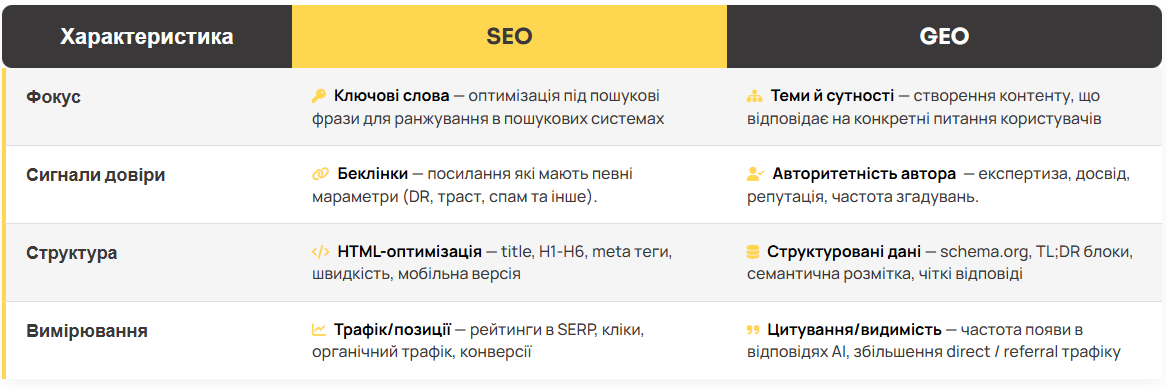
In classic SEO, we compete for rankings. In Generative Engine Optimization (GEO), we compete for mentions and citations in a generated answer. AI typically “chooses” sources based on signals such as:
- crawlability (whether the content is accessible to bots);
- structure (schema/feeds);
- evidence (facts, figures, primary sources, reviews);
- brand authority as an entity (mentions, reputation, data consistency);
- freshness (updates, prices, availability, delivery).
Explicit signals of expertise also help: author/date of update, links to sources, real photos, and specifications.
The key change for E-commerce: AI “prefers” not slogans, but максимально specific answers and transparent purchasing terms. And one more thing: AI traffic in E-commerce often has higher intent. According to Adobe, users who came to retail websites from generative AI assistants were 33% less likely to leave the site immediately (lower bounce rate).
How to “Get Into” AI Recommendations: 4 Levels of Optimization
1) Data Level (must-have for a store)
AI does not “guess” your prices or availability – it reads data. A minimum checklist:
- Micronote Product/Offer: price, currency, availability, brand, GTIN/MPN;
- AggregateRating/Review (where appropriate) + clear review policies;
- canonical, sitemap, robots, speed, mobile-friendliness;
- visible delivery/payment/returns pages (these are often the subject of AI queries);
- duplicate control (filters/parameters/sorting).
For large catalogs, it is critical to have a clean and stable product feed (Merchant Center/marketplaces). This makes the assortment “readable” for shopping responses.
2) Content Level (What AI Actually Quotes)
AI willingly uses materials that:
- answer “how to choose” questions (guides, checklists, comparisons);
- provide usage context (for whom/which scenarios/what compromises);
- include specifics: parameters, examples, “pros/cons”;
- give a short summary at the beginning (TL;DR).
Practice for E-commerce: create a cluster of pages targeting prompts such as:
— “best … for …,” “which is better: A or B,” “what is the difference between …”— “selection by budget,” “top models 2026,” “alternatives to the brand …”
On category/brand pages, add an FAQ with specific answers (no fluff) and update it regularly. On product pages, add blocks like “who it’s for” + “compare with” (internal linking to alternatives).
3) Trust and Entity Level (Why AI “Trusts” You Specifically)
Models prefer brands with independent mentions and consistent facts. PR + SEO works, but with a focus on verifiability:
- reviews/ratings in industry media;
- cases and studies with numbers;
- stable brand profiles (name/contact details/identity);
- reviews on platforms where both people and algorithms read them.
Capgemini reported that 71% of consumers want to see generative AI integrated into the shopping experience. Boston Consulting Group recorded a +35% increase in the use of GenAI in shopping scenarios during February–November 2025. This means that an “AI recommendation” is becoming a form of trust – and the brand must appear verifiable.
4) “Prompt-Fit” and Conversion Level
To enable AI to compile a recommendation from your content blocks:
- provide clear answers in 2–4 sentences (these are most often quoted);
- use tables like “model → who it’s for → key advantage”;
- place purchase terms (delivery, warranty, returns) closer to the top;
- show alternatives and selection options. This reduces the chances that a competitor will “take” the user.
What to Add to Pages So AI Chooses Your Store More Often
- “Who it’s for” + “Who it’s not for” (honesty increases trust).
- A comparison of 3–5 alternatives from your catalog.
- Clear limitations: compatibility, dimensions, комплектation, warranty, delivery times.
- Up-to-date “product status”: availability/price/options — and consistency between the text and structured data.
- Post-purchase content: instructions, care guidelines, usage FAQ.
How to Measure AI Traffic
- Create a segment in GA4 based on referrals/sources (chats and AI search) and track engaged sessions, add_to_cart, and purchase.
- Tag your own placements with UTM parameters (PR, catalogs, partnerships) so that “AI as a channel” is visible in the data.
- Compare quality: in retail, AI referrals demonstrate a lower bounce rate and stronger intent signals.
A Short 30-Day Plan
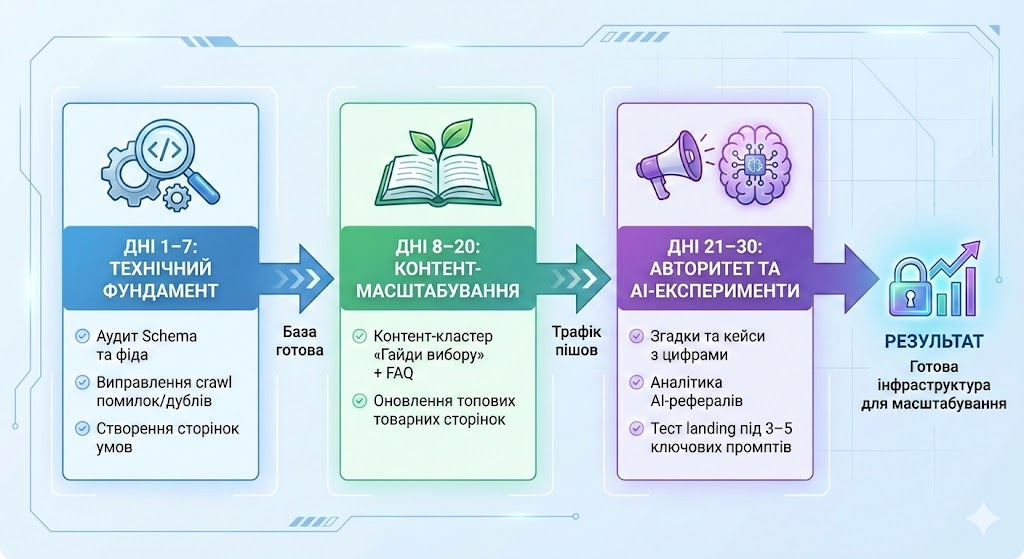
Days 1–7: audit of schema + feed, fix crawl issues/duplicates, update policy pages.
Days 8–20: content cluster of “buying guides” + FAQ, update top product pages.
Days 21–30: mentions/case studies with numbers, AI referral analytics, test a landing page for 3–5 key prompts.
Is AI Really Killing SEO?
AI does not “kill” SEO, it redistributes attention. Structure, evidence, and reputation win. And even a small amount of AI traffic in E-commerce can be valuable because it comes at the decision-making stage.
If you are experiencing difficulties with a GEO strategy, optimization for AI assistants, or measuring this channel, contact Compas Agency.
Author: Artur Kvak is an SEO and AI promotion specialist, working with E-commerce and content strategies that get featured in AI recommendations.
Follow us and register on SalesDoubler platform

SalesDoubler.pro content manager